Arnaldo Drés González is a Venezuelan visual artist based in Hamburg, Germany, exploring the instability of perception, bodily memory, displacement, and the transformation of moving image into spatial and material form. He holds a BFA in Mixed Media from the Universidad Nacional Experimental de las Artes (Caracas) and an MFA from the University of Applied Sciences and Arts (Ottersberg, Germany).
"My moving-image practice explores the fragile boundary between perception, recognition and belief. I use the body, documentary images and digitally transformed recordings as starting points for situations in which visual certainty begins to break down. Through fragmentation, extraction, repetition, concealment, displacement and temporal manipulation, familiar images move between body, landscape, signal, matter and abstraction.
I am interested in the moment when an image can no longer fully guarantee what it appears to show. At this threshold, perception becomes entangled with memory, imagination and projection. The moving image becomes not only a representation, but a space in which recognition is proposed, questioned and continuously reconstructed".
Moving Image Selected Works
Volcano, 2015
Single-channel video, color, sound, loop
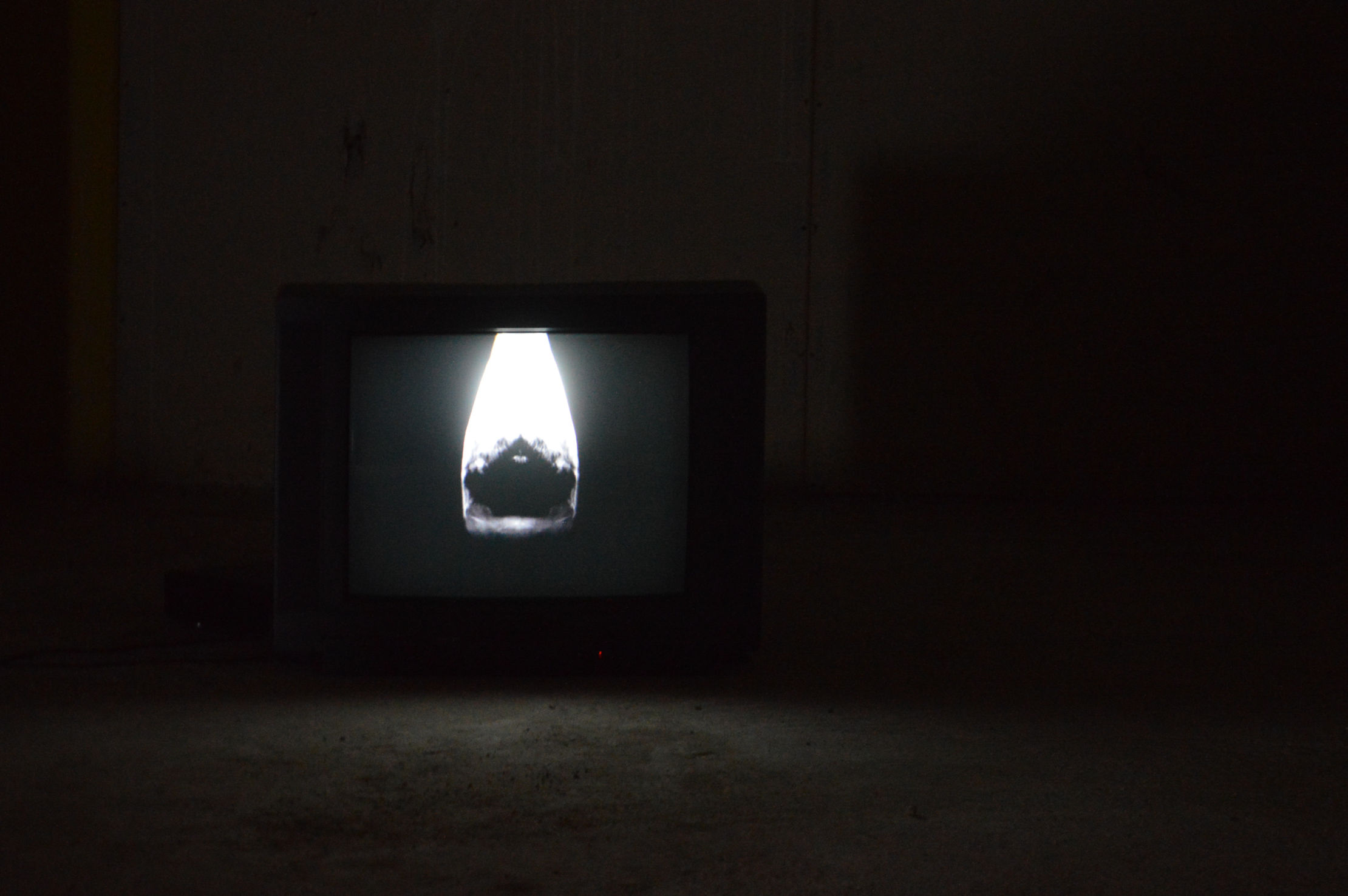
Volcano transforms the act of swallowing into an unstable encounter between anatomy and landscape. Repeated images of the artist’s head, neck and shoulders are multiplied at different scales and temporal intervals, causing the throat to oscillate between bodily detail and geological formation. The repetition intensifies the gesture of swallowing into a cycle of accumulation, pressure and release.
The transformation does not simply turn the body into a landscape; it unsettles the certainty with which the body can be recognized. What initially appears anatomical begins to operate according to another visual logic, somewhere between internal organ, geological formation and imagined terrain. The work uses this slippage to question how quickly perception constructs meaning from familiar forms—and how unstable that meaning becomes when the image no longer confirms what we believe we are seeing.
Lengual, 2016
Single-channel video, black and white, silent, loop
A chroma-keyed fragment of the artist’s tongue is extracted, multiplied and arranged into a circular structure. Detached from the face and from its function in speech, the tongue becomes a moving system whose meaning is no longer secured by language.
The work begins with something immediately recognizable—the tongue—and gradually places that recognition under pressure. Through rotation, repetition and delay, the anatomical fragment becomes simultaneously body, object, sign and abstract image. Its movement remains associated with articulation, but no longer produces language.
Lengual explores the moment in which a familiar bodily form loses the context that allows us to understand it. What remains is a fragment that can still be recognized, but whose function can no longer be taken for granted. The work shifts the tongue from an instrument of communication into an image of unstable meaning, where recognition persists without certainty.
Single-channel video, black and white, sound, 5:12 min
Troscurpos brings together fragments of body, landscape, machinery and historical imagery without allowing them to settle into a single narrative. A digitally fabricated image of an eroded crown appears as an ambiguous archaeological trace, while close-up gestures of hands, skin and folded arms gradually dissolve the human figure into a shifting terrain.
Sea, mist and tarp-covered machinery enter the image as fragments of an environment whose geographical and historical coordinates remain deliberately unstable. The body appears less as an individual figure than as a site where memory, territory and material history overlap.
The crown introduces a symbol associated with power, authority and historical continuity, yet its eroded and digitally constructed appearance undermines its status as evidence. Like the bodily images that surround it, it can be read as object, memory, fiction or trace.
Through this instability, Troscurpos examines how images can carry histories without providing a secure way of interpreting them. The work moves between what can be recognized and what must be imagined, asking how memory and belief enter when visual evidence remains incomplete.
Screenings
2026: Blackwood Filmfestival – Kurzfilmsause Freiburg, Freiburg (Germany) • STARPTELPA Riga Performance Festival (Latvia) • Public Shorts Video Festival, Berlin (Germany)
2025: Special Mention – Festival de Cine de Villa De Leyva (Colombia) • T.I.V.A. Tirana International Video Art Festival (Albania) • KURZFILMTAG, KulturEnergieBunker, Hamburg (Germany) • Écran Libre New Media Festival (Canada) • WNDX Festival of Moving Image (Canada) • Speak Volumes, Out of the Blue Cinema, Paris (France) • Mientras tanto Cine (Uruguay) • Movement and Light, GISELA, Berlin (Germany) • Tendermesh Film Fest, Berlin (Germany)
2024: Rare Effect Festival, Lisbon (Portugal) • Intermediaciones – Video Art and Experimental Video Showcase, Medellín (Colombia).
Radar, 2023
Single-channel video, black and white, sound, 09:34 min, loop
Radar begins with documentary recordings of people and vehicles waiting in lines in Venezuela. Rather than preserving these images as straightforward records of a social reality, the work progressively transforms them through extraction, monochrome processing and slowed temporal movement. Human figures and cars appear as unstable silhouettes that emerge, dissolve and reconfigure across the image.
An asynchronous radar graphic rotates through these sequences, introducing a second system of observation that does not fully correspond to what is being seen. The radar suggests detection, orientation and the possibility of locating something, while the images themselves resist providing a stable point of reference.
The work therefore moves between document and abstraction, evidence and interpretation. The recorded situation remains recognizable, but its transformation makes it increasingly difficult to read the image only as testimony. The viewer is placed in a condition of watching, searching and interpreting without complete visual confirmation.
In this sense, Radar is less concerned with representing a particular crisis than with examining what happens to an image when its documentary certainty begins to dissolve. The work turns the act of looking into a provisional form of orientation: we recognize fragments, construct relationships and search for meaning.
El Impulso, 2016
Single-channel video, black and white, sound, loop
El Impulso disperses the body into a system of movement between distant points. Fragments of a single recording of hands moving beneath a translucent textile are multiplied, displaced and reorganized until the original gesture becomes difficult to locate as a continuous bodily action.
The repeated fragments appear to travel, converge, separate and redirect one another, producing a visual structure that can be read simultaneously as bodily movement, transmission, trajectory or migration. The body is no longer presented as a stable figure but as a sequence of appearances moving through an indeterminate visual space.
Inspired by migratory movements, the work approaches displacement not through literal representation but through the behavior of the image itself. A single bodily source becomes a dispersed system of trajectories, in which origin and destination remain perceptually unstable. What appears to be a body can become a signal; what appears to be a trajectory can become an abstract composition.
El Impulso marks an important shift in my practice: the recorded body begins to function not only as an image of something, but as material that can be multiplied, displaced and reorganized into new visual situations.
Pulsations, 2026–ongoing
Single-channel video, black and white, silent, loop
Pulsations begins with recordings of the artist’s hands moving beneath a translucent textile. Through digital extraction, mirroring and recomposition, these gestures are transformed into ambiguous organic forms that expand, contract, open, close and repeat at different rhythms.
Presented as a modular field, the sequences invite the viewer to compare forms and behaviours: some appear identical, others seem to respond to one another, while their bodily origin remains concealed. The image becomes a field in which recognition is constantly proposed and withdrawn.
The work draws attention to the human tendency to construct relationships between forms, to identify patterns and to attribute behaviour even when the available information is incomplete. A gesture can appear anatomical, microscopic, biological or entirely imagined without becoming definitively any of these things.
Repetition therefore operates not only as a formal device but as a perceptual mechanism. It produces a situation in which the viewer is repeatedly asked to decide what is being seen, while the image continuously resists confirmation.